とびうお座ガンマ星
とびうお座γ星(とびうおざガンマせい、γ Volantis、γ Vol)は、とびうお座の二重星である[4]。見かけの合成等級では、とびうお座で最も明るくみえる恒星である[5]。2つの恒星は、連星ではないかと考えられ、また、変光が疑われている[5][6]。
| とびうお座γ星 γ Volantis | ||
|---|---|---|
| 星座 | とびうお座 | |
| 見かけの等級 (mv) | 3.61[1] | |
| 位置 | ||
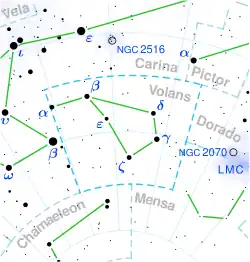  | ||
とびうお座γ星の位置(赤丸)
| ||
| 物理的性質 | ||
| 色指数 (B-V) | 0.92[1] | |
| 色指数 (U-B) | 0.61[1] | |
| 他のカタログでの名称 | ||
| Dun 42[2], CPD-70 600[3], IDS 07096-7020[1] | ||
| ■Template (■ノート ■解説) ■Project | ||
位置・外見
とびうお座γ星は、天の南極からおよそ20度の位置にあり、大マゼラン雲から東南東におよそ9度の所にみえる[7]。
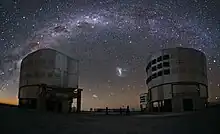
とびうお座γ星は、肉眼では分解できないが、望遠鏡でみるととびうお座γ1星ととびうお座γ2星の2つの恒星からなり、離角が14秒、明るさは3.8等と5.7等、小望遠鏡できれいにみることができる美しい二重星である[5][4]。明るい方のγ2星は黄金色、暗い方のγ1星は白ないし黄白色にみえる[7][4]。見かけの合成等級は3.6で、とびうお座の中では最も明るくみえる恒星である[5][4]。
特徴
| とびうお座γ2星 γ2 Volantis | ||
|---|---|---|
| 見かけの等級 (mv) | 3.78[3] | |
| 位置 元期:J2000.0 | ||
| 赤経 (RA, α) | 07h 08m 44.8656955896s[9] | |
| 赤緯 (Dec, δ) | −70° 29′ 56.149447560″[9] | |
| 視線速度 (Rv) | 2.8 ± 0.7 km/s[9] | |
| 固有運動 (μ) | 赤経: 23.620 ミリ秒/年[9] 赤緯: 108.653 ミリ秒/年[9] | |
| 年周視差 (π) | 24.4775 ± 0.1130ミリ秒[9] (誤差0.5%) | |
| 距離 | 133.2 ± 0.6 光年[注 1] (40.9 ± 0.2 パーセク[注 1]) | |
| 物理的性質 | ||
| 質量 | 2.49+0.50 −0.90 M☉[10] | |
| 表面重力 (log g) | 2.7 cgs[11] | |
| スペクトル分類 | K0 III[3] | |
| 光度 | 58.9+4.2 −3.9 L☉[10] | |
| 有効温度 (Teff) | 4,866 ± 34 K[11] | |
| 色指数 (B-V) | 1.04[3] | |
| 色指数 (U-B) | 0.88[3] | |
| 金属量[Fe/H] | -0.01 ± 0.03[11] | |
| 他のカタログでの名称 | ||
| HD 55865, FK5 1189, HIP 34481, HR 2736, NSV 3448, SAO 256374[9] | ||
| ■Template (■ノート ■解説) ■Project | ||
| とびうお座γ1星 γ1 Volantis | ||
|---|---|---|
| 見かけの等級 (mv) | 5.69[3] | |
| 位置 元期:J2000.0 | ||
| 赤経 (RA, α) | 07h 08m 42.3702708288s[12] | |
| 赤緯 (Dec, δ) | −70° 29′ 49.526709864″[12] | |
| 視線速度 (Rv) | 4.5 ± 0.8 km/s[12] | |
| 固有運動 (μ) | 赤経: 11.069 ミリ秒/年[12] 赤緯: 107.302 ミリ秒/年[12] | |
| 年周視差 (π) | 22.7501 ± 0.4619ミリ秒[12] (誤差2%) | |
| 距離 | 143 ± 3 光年[注 1] (44 ± 0.9 パーセク[注 1]) | |
| 絶対等級 (MV) | 2.51[13] | |
| 物理的性質 | ||
| 半径 | 2.473 R☉[14] | |
| 質量 | 1.69 M☉[15] | |
| 表面重力 (log g) | 2.71 cgs[15] | |
| 自転速度 | 4.4 ± 0.2 km/s[13] | |
| スペクトル分類 | F2V[3] | |
| 光度 | 10.435 L☉[14] | |
| 有効温度 (Teff) | 6,541 K[13] | |
| 色指数 (B-V) | 0.40[3] | |
| 色指数 (U-B) | 0.04[3] | |
| 金属量[Fe/H] | 0.12[16] | |
| 年齢 | 1.4 ± 0.1 ×10⁹ 年[16] | |
| 地球から見た位置 (とびうお座γ2星との関係) | ||
| 元期 | 2021 | |
| 位置角 | 299°[17] | |
| 角距離 | 14.5秒[17] | |
| 他のカタログでの名称 | ||
| HD 55864, HIP 34473, HR 2735, SAO 256373[12] | ||
| ■Template (■ノート ■解説) ■Project | ||
とびうお座γ2星は橙色に輝くK型巨星で、スペクトル型はK0 IIIと分類され、見かけの等級は3.78である[3]。表面の有効温度はおよそ4,900 Kで、K型星の範囲に合致する[11][18]。とびうお座γ1星はF型主系列星で、スペクトル型はF2 Vと分類され、見かけの等級は5.69である[3]。表面の有効温度はおよそ6,500 Kで、F型星であることと整合する[13][18]。
とびうお座γ星が二重星であることを最初に記録したのは、ジェームズ・ダンロップである[17][19]。以降、150年以上監視されており、γ1星とγ2星は固有運動が共通する連星とみなされた[5][20]。相対位置の変化がみられ、軌道曲線が描けるようにはなっているが、情報は限定的で軌道要素を十分制限できていない[5][21]。天球に投影したγ1星とγ2星の間の距離は、およそ600 auに相当するが、両者の年周視差の差まで考慮した実際の距離の見積りは2.7パーセクにもなり、連星ではない可能性もある[5][21]。
とびうお座γ星は、ベンジャミン・グールドによって光度変化があるのではないかと言及され、変光星総合カタログに変光星候補として報告された[22][6]。グールドは、合成等級で3.56等から3.62等まで変化するとしたが、変光星候補はとびうお座γ2星に紐づけられている[22][6][3]。しかし、その後は変光が観測されず、確定した変光星にはなっていない[1][6]。
脚注
注釈
- パーセクは1 ÷ 年周視差(秒)より計算、光年は1÷年周視差(秒)×3.2615638より計算
出典
- Hurly, Patrick R.; Warner, Brian (1983-03-01), “Area scanner observations of close visual double stars - II. Results for 153 southern stars”, Monthly Notices of the Royal Astronomical Society 202 (3): 761-765, Bibcode: 1983MNRAS.202..761H, doi:10.1093/mnras/202.3.761
- van Albada-van Dien, E. (1983-05), “Photographic observations of visual double stars”, Astronomy & Astrophysics Supplement Series 52: 193-202, Bibcode: 1983A&AS...52..193V
- Hoffleit, D.; Warren, W. H., Jr. (1995-11), “Bright Star Catalogue, 5th Revised Ed.”, VizieR On-line Data Catalog: V/50, Bibcode: 1995yCat.5050....0H
- DK (2012-06-18). Nature Guide: Stars and Planets: The World in Your Hands. DK Nature Guide. Dorling Kindersley. p. 322. ISBN 9780756690403
- Kaler, James B.. “GAMMA VOL (Gamma Volantis)”. Stars. University of Illinois. 2023年9月22日閲覧。
- Samus, N. N.; et al. (2009-01), “General Catalogue of Variable Stars”, VizieR On-line Data Catalog: B/gcvs, Bibcode: 2009yCat....102025S
- Bakich, Michael E. (2010-06-11). 1,001 Celestial Wonders to See Before You Die: The Best Sky Objects for Star Gazers. Patrick Moore's Practical Astronomy Series. New York, NY: Springer Science+Business Media. p. 13. ISBN 978-1-4419-1776-8
- “An Emu in the Sky over Paranal”. ESO (2014年9月29日). 2023年9月22日閲覧。
- “gam02 Vol -- High Proper Motion Star”. SIMBAD. CDS. 2023年9月22日閲覧。
- Charbonnel, C.; et al. (2020-01), “Lithium in red giant stars: Constraining non-standard mixing with large surveys in the Gaia era”, Astronomy & Astrophysics 633: A34, Bibcode: 2020A&A...633A..34C, doi:10.1051/0004-6361/201936360
- Alves, S.; et al. (2015-04), “Determination of the spectroscopic stellar parameters for 257 field giant stars”, Monthly Notices of the Royal Astronomical Society 448 (3): 2749-2765, Bibcode: 2015MNRAS.448.2749A, doi:10.1093/mnras/stv189
- “gam01 Vol -- High Proper Motion Star”. SIMBAD. CDS. 2023年9月22日閲覧。
- Ammler-von Eiff, Matthias; Reiners, Ansgar (2012-06), “New measurements of rotation and differential rotation in A-F stars: are there two populations of differentially rotating stars?”, Astronomy ∓ Astrophysics 542: A116, Bibcode: 2012A&A...542A.116A, doi:10.1051/0004-6361/201118724
- Schofield, Mathew; et al. (2019-03), “The Asteroseismic Target List for Solar-like Oscillators Observed in 2 minute Cadence with the Transiting Exoplanet Survey Satellite”, Astrophysical Journal Supplement Series 241 (1): 12, Bibcode: 2019ApJS..241...12S, doi:10.3847/1538-4365/ab04f5
- Casagrande, L.; et al. (2011-06), “New constraints on the chemical evolution of the solar neighbourhood and Galactic disc(s). Improved astrophysical parameters for the Geneva-Copenhagen Survey”, Astronomy & Astrophysics 530: A138, Bibcode: 2011A&A...530A.138C, doi:10.1051/0004-6361/201016276
- Holmberg, J.; Nordström, B.; Andersen, J. (2009-07), “The Geneva-Copenhagen survey of the solar neighbourhood. III. Improved distances, ages, and kinematics”, Astronomy & Astrophysics 501 (3): 941-947, Bibcode: 2009A&A...501..941H, doi:10.1051/0004-6361/200811191
- Mason, Brian D.; et al. (2023-06), “The Washington Visual Double Star Catalog”, VizieR On-line Data Catalog: B/wds, Bibcode: 2023yCat....102026M
- “The Colour of Stars”. Australia Telescope National Facility. Commonwealth Scientific and Industrial Research Organisation. 2023年9月22日閲覧。
- Dunlop, James (1829), “Approximate Places of Double Stars in the Southern Hemisphere, observed at Paramatta in New South Wales”, Memoirs of the Royal Astronomical Society 3 (2): 257-276, Bibcode: 1829MmRAS...3..257D
- Eggen, Olin J. (1989-01), “Large and Kinematically Unbiased Samples of G- and K-Type Stars. III. Evolved Young Disk Stars in the Bright Star Sample”, Publications of the Astronomical Society of the Pacific 101: 54-94, Bibcode: 1989PASP..101...54E, doi:10.1086/132404
- Letchford, Roderick; White, Graeme; Ernest, Allan (2019-07), “The Southern Double Stars of James Dunlop IV: Rectilinear and Orbital Motion of Some Very Slow Moving Doubles” (PDF), Journal of Double Star Observations 15 (3): 394-402, Bibcode: 2019JDSO...15..394L
- Gould, Benjamin Apthorp (1879), “Uranometria Argentina: Brightness and position of every fixed star, down to the seventh magnitude, within one hundred degrees of the South Pole; with atlas”, Resultados del Observatorio Nacional Argentino 1: 140, Bibcode: 1879RNAO....1....1G
関連項目
外部リンク
- Blane, Dave (2014年1月25日). “Gamma Volantis - February double star”. Astronomical Society pf Southern Africa. 2023年9月22日閲覧。
- “γ1 Volantis”. alcyone software. 2023年9月22日閲覧。
- “γ2 Volantis”. alcyone software. 2023年9月22日閲覧。
- “VSX: Detail for NSV 3448”. The International Variable Star Index. AAVSO (2010年1月18日). 2023年9月22日閲覧。