ジュリエット (衛星)
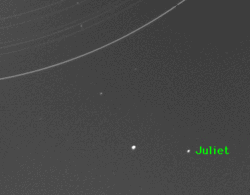
ジュリエット[7][8] (Uranus XI Juliet) は、天王星の第11衛星である。
| ジュリエット Juliet | |
|---|---|
 | |
| 仮符号・別名 | Uranus XI S/1986 U 2 |
| 分類 | 天王星の衛星 |
| 発見 | |
| 発見日 | 1986年1月9日[1] |
| 発見者 | ボイジャー2号 S・P・シノット (ボイジャー撮像チーム) |
| 軌道要素と性質 | |
| 平均公転半径 | 64,358.222 ± 0.048 km[2] |
| 離心率 (e) | 0.00066 ± 0.000087[2] |
| 公転周期 (P) | 0.493065490 日[2] |
| 軌道傾斜角 (i) | 0.06546°[2] (天王星の赤道に対して) |
| 近日点引数 (ω) | 223.819°[3] |
| 昇交点黄経 (Ω) | 200.155°[3] |
| 平均近点角 (M) | 244.696°[3] |
| 天王星の衛星 | |
| 物理的性質 | |
| 三軸径 | 150 × 74 × 74 km[4] |
| 平均半径 | 46.8 ± 4 km[4] |
| 表面積 | 27,523.37 km2[1] |
| 体積 | 429,365 km3[1] |
| 質量 | 5.6×10¹⁷ kg[5] |
| 平均密度 | 1.3 g/cm3[5] (仮定値) |
| 表面重力 | 0.017 m/s2[1] |
| 脱出速度 | ~0.040 km/s |
| 自転周期 | 同期回転[4] |
| アルベド(反射能) | 0.08 ± 0.01[6] |
| 赤道傾斜角 | 0[4] |
| 表面温度 | ~64 K |
| ■Template (■ノート ■解説) ■Project | |
ジュリエットは、1986年1月3日にボイジャー2号が撮影した画像の中から、ボイジャーの画像解析チームによって発見された[9]。発見は同年1月16日に国際天文学連合のサーキュラーで公表され、S/1986 U 2 という仮符号が与えられた[9]。その後1988年6月8日に、ウィリアム・シェイクスピアの戯曲『ロミオとジュリエット』のヒロイン・ジュリエットに因んで命名された[10][11]。また、Uranus XI という確定番号が与えられた[11]。
ボイジャー2号が撮影した画像の中では、ジュリエットは長軸を天王星の方へ向けた細長い物体として写っていた。ジュリエットの長軸と短軸の比率は 0.5 ± 0.3 と非常に細長い形状をしていることが分かっている[4]。また、表面は灰色である[4]。測定されたアルベドは 0.08 と低く、表面はC型小惑星に見られるような、暗く変性していない炭素豊富な物質に覆われている可能性がある[1]。
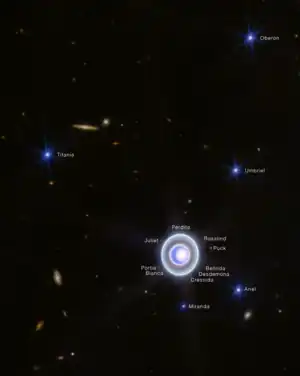
ジュリエットは、測光的特徴や軌道要素がよく似たビアンカ、クレシダ、デズデモーナ、ロザリンド、ポーシャ、キューピッド、ベリンダ、ペルディータとともに、ポーシャ群を形成している[6][12]。
ジュリエットを含む内側の衛星のいくつかは長期的には軌道が不安定であることが示されており、ジュリエットは今後400万〜1億年のうちにデズデモーナと衝突する可能性があることが指摘されている[13]。
出典
- “In Depth | Juliet – Solar System Exploration: NASA Science”. アメリカ航空宇宙局 (2017年12月5日). 2018年12月25日閲覧。
- Jacobson, R. A. (1998). “The Orbits of the Inner Uranian Satellites From Hubble Space Telescope and Voyager 2 Observations”. The Astronomical Journal 115 (3): 1195–1199. Bibcode: 1998AJ....115.1195J. doi:10.1086/300263.
- Jet Propulsion Laboratory (2013年8月23日). “Planetary Satellite Mean Orbital Parameters”. Jet Propulsion Laboratory Solar System Dynamics. ジェット推進研究所. 2018年12月25日閲覧。
- Karkoschka, Erich (2001). “Voyager's Eleventh Discovery of a Satellite of Uranus and Photometry and the First Size Measurements of Nine Satellites”. Icarus 151 (1): 69–77. Bibcode: 2001Icar..151...69K. doi:10.1006/icar.2001.6597.
- Jet Propulsion Laboratory (2015年2月19日). “Planetary Satellite Physical Parameters”. Jet Propulsion Laboratory Solar System Dynamics. ジェット推進研究所. 2018年12月25日閲覧。
- Karkoschka, Erich (2001). “Comprehensive Photometry of the Rings and 16 Satellites of Uranus with the Hubble Space Telescope”. Icarus 151 (1): 51–68. Bibcode: 2001Icar..151...51K. doi:10.1006/icar.2001.6596.
- 『オックスフォード天文学辞典』(初版第1刷)朝倉書店、193頁。ISBN 4-254-15017-2。
- “太陽系内の衛星表”. 国立科学博物館. 2019年3月9日閲覧。
- Brian G. Marsden (1986年1月16日). “IAUC 4164: Sats OF URANUS; R Leo; NOVAE”. Central Bureau for Astronomical Telegrams. 国際天文学連合. 2018年12月25日閲覧。
- “Planet and Satellite Names and Discoverers”. Planetary Names. 国際天文学連合. 2015年1月11日閲覧。
- Brian G. Marsden (1988年6月8日). “IAUC 4609: ASM 2000+25; Sats OF SATURN AND URANUS; 3C 279, PKS 1510-089 AND OJ 287”. Central Bureau for Astronomical Telegrams. 国際天文学連合. 2018年12月25日閲覧。
- Scott S. Sheppard. “Uranus Satellite and Moon Data”. Carnegie Science. 2018年12月25日閲覧。
- Duncan, Martin J.; Lissauer, Jack J. (1997). “Orbital Stability of the Uranian Satellite System”. Icarus 125 (1): 1–12. Bibcode: 1997Icar..125....1D. doi:10.1006/icar.1996.5568.
外部リンク

This article is issued from Wikipedia. The text is licensed under Creative Commons - Attribution - Sharealike. Additional terms may apply for the media files.