ロザリンド (衛星)
ロザリンド[7][8] (Uranus XIII Rosalind) は、天王星の第13衛星である。
| ロザリンド Rosalind | |
|---|---|
 | |
| 仮符号・別名 | Uranus XIII S/1986 U 4 |
| 分類 | 天王星の衛星 |
| 発見 | |
| 発見日 | 1986年1月13日[1] |
| 発見者 | ボイジャー2号 S・P・シノット (ボイジャー撮像チーム) |
| 軌道要素と性質 | |
| 平均公転半径 | 69,926.795 ± 0.053 km[2] |
| 離心率 (e) | 0.00011 ± 0.000103[2] |
| 公転周期 (P) | 0.558459529 日[2] |
| 軌道傾斜角 (i) | 0.27876°[2] (天王星の赤道に対して) |
| 近日点引数 (ω) | 140.477°[3] |
| 昇交点黄経 (Ω) | 12.847°[3] |
| 平均近点角 (M) | 136.181°[3] |
| 天王星の衛星 | |
| 物理的性質 | |
| 三軸径 | 72 × 72 × 72 km[4] |
| 平均半径 | 36 ± 6 km[4] |
| 表面積 | 16,286.02 km2[1] |
| 体積 | 195,432 km3[1] |
| 質量 | 2.5×10¹⁷ kg[5] |
| 平均密度 | 1.3 g/cm3[5] (仮定値) |
| 表面重力 | 0.013 m/s2[1] |
| 脱出速度 | ~0.031 km/s |
| 自転周期 | 同期回転[4] |
| アルベド(反射能) | 0.08 ± 0.01[6] |
| 赤道傾斜角 | 0[4] |
| 表面温度 | ~64 K |
| ■Template (■ノート ■解説) ■Project | |
ロザリンドは、1986年1月13日にボイジャー2号が撮影した画像の中から、ボイジャーの画像解析チームによって発見された[9]。発見は同年1月16日に国際天文学連合のサーキュラーで公表され、S/1986 U 4 という仮符号が与えられた[9]。その後1988年6月8日に、ウィリアム・シェイクスピアの喜劇『お気に召すまま』に登場する追放された公爵の娘ロザリンドに因んで命名された[10][11]。また、Uranus XIII という確定番号が与えられた[11]。
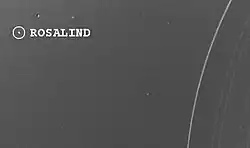
ボイジャー2号が撮影した画像の中では、ロザリンドはほぼ球形の天体として写っていた。ロザリンドの長軸と短軸の比率は 0.8〜1.0 と推定されている[4]。また、表面は灰色である[4]。
ロザリンドは、測光的特徴や軌道要素がよく似たビアンカ、クレシダ、デズデモーナ、ポーシャ、ジュリエット、キューピッド、ベリンダ、ペルディータとともに、ポーシャ群を形成している[6][12]。
ロザリンドは、コーディリアとの 3:5 軌道共鳴に非常に近い位置を公転している[13]。また、ペルディータとの 7:8 の軌道共鳴にも近い[14]。
出典
- “In Depth | Rosalind – Solar System Exploration: NASA Science”. アメリカ航空宇宙局 (2017年12月5日). 2018年12月25日閲覧。
- Jacobson, R. A. (1998). “The Orbits of the Inner Uranian Satellites From Hubble Space Telescope and Voyager 2 Observations”. The Astronomical Journal 115 (3): 1195–1199. Bibcode: 1998AJ....115.1195J. doi:10.1086/300263.
- Jet Propulsion Laboratory (2013年8月23日). “Planetary Satellite Mean Orbital Parameters”. Jet Propulsion Laboratory Solar System Dynamics. ジェット推進研究所. 2018年12月25日閲覧。
- Karkoschka, Erich (2001). “Voyager's Eleventh Discovery of a Satellite of Uranus and Photometry and the First Size Measurements of Nine Satellites”. Icarus 151 (1): 69–77. Bibcode: 2001Icar..151...69K. doi:10.1006/icar.2001.6597.
- Jet Propulsion Laboratory (2015年2月19日). “Planetary Satellite Physical Parameters”. Jet Propulsion Laboratory Solar System Dynamics. ジェット推進研究所. 2018年12月25日閲覧。
- Karkoschka, Erich (2001). “Comprehensive Photometry of the Rings and 16 Satellites of Uranus with the Hubble Space Telescope”. Icarus 151 (1): 51–68. Bibcode: 2001Icar..151...51K. doi:10.1006/icar.2001.6596.
- 『オックスフォード天文学辞典』(初版第1刷)朝倉書店、444頁。ISBN 4-254-15017-2。
- “太陽系内の衛星表”. 国立科学博物館. 2019年3月9日閲覧。
- Brian G. Marsden (1986年1月16日). “IAUC 4164: Sats OF URANUS; R Leo; NOVAE”. Central Bureau for Astronomical Telegrams. 国際天文学連合. 2018年12月25日閲覧。
- “Planet and Satellite Names and Discoverers”. Planetary Names. 国際天文学連合. 2015年1月11日閲覧。
- Brian G. Marsden (1988年6月8日). “IAUC 4609: ASM 2000+25; Sats OF SATURN AND URANUS; 3C 279, PKS 1510-089 AND OJ 287”. Central Bureau for Astronomical Telegrams. 国際天文学連合. 2018年12月25日閲覧。
- Scott S. Sheppard. “Uranus Satellite and Moon Data”. Carnegie Science. 2018年12月25日閲覧。
- Murray, Carl D.; Thompson, Robert P. (1990-12-06). “Orbits of shepherd satellites deduced from the structure of the rings of Uranus”. Nature 348 (6301): 499–502. Bibcode: 1990Natur.348..499M. doi:10.1038/348499a0. ISSN 0028-0836.
- Showalter, M. R. (2006). “The Second Ring-Moon System of Uranus: Discovery and Dynamics”. Science 311 (5763): 973–977. doi:10.1126/science.1122882. ISSN 0036-8075.
外部リンク

This article is issued from Wikipedia. The text is licensed under Creative Commons - Attribution - Sharealike. Additional terms may apply for the media files.