二セレン化モリブデン
二セレン化モリブデン (Molybdenum diselenide、MoSe2) は、モリブデンとセレンの無機化合物である。
| 二セレン化モリブデン | |
|---|---|
 | |
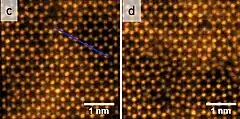 Top-view atomic images of MoSe2 before and after (right) ion irradiation[1] | |
bis(selanylidene)molybdenum | |
別称 molybdenum diselenide, molybdenumdiselenide, molybdenum selenide, diselanylidenemolybdenum, molybdenum(IV) selenide | |
| 識別情報 | |
| CAS登録番号 | 12058-18-3 |
| PubChem | 82894 |
| |
| 特性 | |
| 化学式 | MoSe2 |
| モル質量 | 253.86 g/mol[2] |
| 外観 | crystalline solid |
| 密度 | 6.90 g/cm3[2] |
| 融点 |
>1200 °C[2] |
| バンドギャップ | ~0.85 eV (indirect, bulk) ~1.5 eV (direct, monolayer)[3][4] |
| 構造 | |
| 結晶構造 | hP6, space group P63/mmc, No 194[5] |
| 格子定数 (a, b, c) | a = 0.3283 nm Å |
| 配位構造 | Trigonal prismatic (MoIV) Pyramidal (Se2−) |
| 関連する物質 | |
| その他の陰イオン | Molybdenum dioxide Molybdenum disulfide Molybdenum ditelluride Tantalum diselenide |
| その他の陽イオン | Tungsten diselenide |
| 特記なき場合、データは常温 (25 °C)・常圧 (100 kPa) におけるものである。 | |
その構造はMoS2の構造に似ている[6]。このカテゴリーの化合物は、遷移金属ジカルコゲニド(Transition Metal Di-Chalcogenides)、略してTMDCとして知られている。これらの化合物は、名前が示すように、遷移金属と元素周期表の第16族の元素で構成されている。MoS2と比較して、MoSe2はより高い電気伝導率を示す[7]。
構造
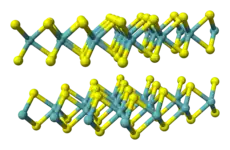
多くのTMDCと同様、MoSe2は強い面内結合と弱い面外相互作用を持つ層状材料である。これらの相互作用により、単一単位胞の厚さの二次元層への剥離が起こる[8]。
これらのTMDCの最も一般的な形式は、セレン・イオン間に挟まれたモリブデンの3層を持ち、三角柱状の金属結合配位を引き起こすが、化合物が剥離すると八面体になる。これらの化合物の金属イオンは6つのSe2−イオンに囲まれている。Moの配位幾何学は、八面体や三角柱として見られることもある[9]。
合成
MoSe2の合成には、封管内でのモリブデンとセレンの高温での直接反応が含まれる。ハロゲン (通常は臭素またはヨウ素) による化学蒸気輸送は、非常に低い圧力 (10-6torr未満) および非常に高い温度 (600~700°C) で化合物を精製するために使用される。強い発熱反応による爆発を防ぐために、非常に徐々に加熱する必要がある。化学量論層は、サンプルが冷却されるにつれて六方晶系構造で結晶化する[9]。過剰なセレンは真空下での昇華によって除去できる[10]。MoSe2の合成反応は次のとおり:
Mo + 2 Se → MoSe2
脚注
- Iberi, Vighter; Liang, Liangbo; Ievlev, Anton V.; Stanford, Michael G.; Lin, Ming-Wei; Li, Xufan; Mahjouri-Samani, Masoud; Jesse, Stephen et al. (2016). “Nanoforging Single Layer MoSe2 Through Defect Engineering with Focused Helium Ion Beams”. Scientific Reports 6: 30481. Bibcode: 2016NatSR...630481I. doi:10.1038/srep30481. PMC 4969618. PMID 27480346.
- Haynes, William M., ed (2011). 化学と物理のCRCハンドブック (92nd ed.). CRC Press. p. 4.76. ISBN 1439855110
- Yun, Won Seok; Han, S. W.; Hong, Soon Cheol; Kim, In Gee; Lee, J. D. (2012). “Thickness and strain effects on electronic structures of transition metal dichalcogenides: 2H-MX2 semiconductors (M = Mo, W; X = S, Se, Te)”. Physical Review B 85 (3): 033305. Bibcode: 2012PhRvB..85c3305Y. doi:10.1103/PhysRevB.85.033305.
- Kioseoglou, G.; Hanbicki, A. T.; Currie, M.; Friedman, A. L.; Jonker, B. T. (2016). “Optical polarization and intervalley scattering in single layers of MoS2 and MoSe2”. Scientific Reports 6: 25041. arXiv:1602.00640. Bibcode: 2016NatSR...625041K. doi:10.1038/srep25041. PMC 4844971. PMID 27112195.
- Agarwal, M. K.; Patel, P. D.; Joshi, R. M. (1986). “Growth conditions and structural characterization of MoSexTe2−x (0 ⩽ x ⩽ 2) single crystals”. Journal of Materials Science Letters 5: 66–68. doi:10.1007/BF01671439.
- Greenwood, N. N.; Earnshaw, A. (11 November 1997). Chemistry of the Elements. Elsevier. pp. 1017–1018. ISBN 978-0-08-050109-3
- Eftekhari, Ali (2017). “Molybdenum Diselenide (MoSe2) for Energy Storage, Catalysis, and Optoelectronics”. Applied Materials Today 8: 1–16. doi:10.1016/j.apmt.2017.01.006.
- Wang, Qing Hua; Kalantar-Zadeh, Kourosh; Kis, Andras; Coleman, Jonathan N.; Strano, Michael S. (2012). “Electronics and optoelectronics of two-dimensional transition metal dichalcogenides”. Nature Nanotechnology 7 (11): 699–712. Bibcode: 2012NatNa...7..699W. doi:10.1038/nnano.2012.193. PMID 23132225.
- Parilla, P.; Dillon, A.; Parkinson, B.; Jones, K.; Alleman, J.; Riker, G.; Ginley, D.; Heben, M; Formation of Nanooctahedra in Molybdenum Disulfide and Molybdenum Diselenide Using Pulsed Vapor Transport doi:10.1021/jp036202
- Al-hilli, A.; Evans, L. The Preparation and Properties of Transition Metal Dichalcogenide Single Crystals. Journal of Crystal Growth. 1972. 15, 93–101. doi:10.1016/0022-0248(72)90129-7
- “Scalable CVD process for making 2-D molybdenum diselenide”. Rdmag.com (2014年4月4日). 2014年4月9日閲覧。
- Choi, H. M. T.; Beck, V. A.; Pierce, N. A. (2014). “Next-Generation in Situ Hybridization Chain Reaction: Higher Gain, Lower Cost, Greater Durability”. ACS Nano 8 (5): 4284–94. doi:10.1021/nn405717p. PMC 4046802. PMID 24712299.
- Home. mindat.org.