太陽系の天体で最も高い山の一覧
太陽系の天体で最も高い山の一覧(たいようけいのてんたいで もっともたかいやまのいちらん)では、太陽系の天体の中で最も高い山を一覧に示す。場合によっては異なる基準の最高点も記載されている。
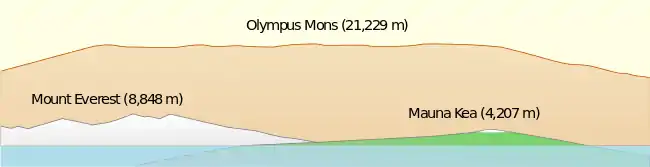
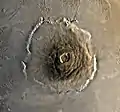
火星にある楯状火山であるオリンポス山は高さ21.9kmで、太陽系の惑星の中で最も高い山である。1971年に発見されてから40年間、既知の太陽系内の山で最も高い山であったが、2011年にベスタにあるクレーター、レアシルヴィアの中央丘は、同等以上の高さであることが判明した[† 1]。
一覧
他の天体には地球における海抜と同等の基準が存在しないため、高さは基底(山麓)から頂上の比高とする。
| 天体 | 最高点 | 高さ | 起源 | 備考 |
|---|---|---|---|---|
| 水星 | カロリス山脈 (Caloris Montes) | 3,000m以下[1][2] | 天体衝突[3] | カロリス盆地ができた際の衝突によって形成された。 |
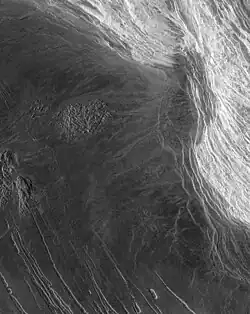
| 金星 | マクスウェル山 | 約6,400m[4] | 地殻運動[5] | 恐らく硫化鉛である、金属の金星の雪がある[6] |
| マアト山 | 約4,900m [7] | 火山活動[8] | 金星で最も高い火山。 | |
| 地球 | マウナ・ケア山 と マウナ・ロア山 | 10,200m[9] | 火山活動 | 山の4,205mの部分のみが海面より上に出ている。 |
| ハレアカラ山 | 9,100m[10] | 火山活動 | 山の3,100mの部分のみが海面より上に出ている。 | |
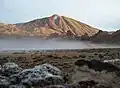
| テイデ山(ピコ・デル・テイデ) | 7,500m[11] | 火山活動 | 海抜は3,718m[11]。 | |
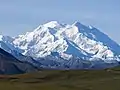
| デナリ(マッキンリー山) | 5,300 - 5,900m[12] | 地殻運動 | 陸地の基底からの比高が地球上で最も高い[13][† 2] | |
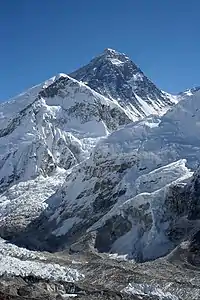
| エヴェレスト山(チョモランマ) | 3,600 - 4,600m[14] | 地殻運動 | 北の麓から4,600m、南の麓から3,600mである[† 3]。 | |
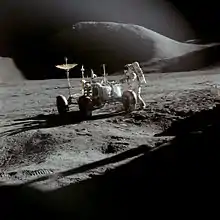
| 月 | ホイヘンス山 | 5,500m[15][16] | 天体衝突 | 雨の海ができた際の衝突によって形成された。 |
| ハドリー山 | 4,500m[15][16] | 天体衝突 | 雨の海ができた際の衝突によって形成された。 | |
| リュムケル山 | 1,100m[17] | 火山活動 | 月面最大の火山構造物[17] | |
| 火星 | オリンポス山 | 21,900m[18][19] | 火山活動 | 1000km離れた北部の平原より26km盛りあがっている[20]。 |
| アスクレウス山 | 14,900m[18] | 火山活動 | タルシス三山のうち最も高い山。 | |
| エリシウム山 | 12,600m[18] | 火山活動 | エリシウムで最も高い火山。 | |
| アルシア山 | 11,700m[18] | 火山活動 | 頂上のカルデラは直径108 - 138kmに亘る[18] | |
| パヴォニス山 | 8,400m[18] | 火山活動 | 頂上のカルデラは4,800mの深さ[18]。 | |
| アンセリス山 (Anseris Mons) | 6,200m[21] | 天体衝突 | 火星の非火山性地形の中で最も高い。ヘラス平原ができた際の衝突によって形成された。 | |
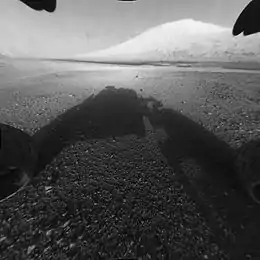
| アイオリス山(シャープ山) | 4,500 - 5,500m[22][† 4]。 | 堆積作用[† 5] | ゲールが作られた際に形成された(ゲールの中央丘である)。[26]北の麓から5,500m、南の麓から4,500mである。 | |
| ベスタ | レアシルヴィアの中央丘 | 22,000m[27][28] | 天体衝突 | 太陽系の天体の最も大きなクレーターの一覧も参照。 |
| イオ | ボオサウレ山脈 (Boösaule Montes) "South"[29] | 17,500 - 18,200m[30] | 地殻運動 | 南東の縁には15kmの高い崖がある[31]。 |
| イオニア山東峰 (Ionian Mons east ridge) | 約12,700m[31][32] | 地殻運動 | 湾曲した二重隆起の形状をしている。 | |
| エヴィア山脈 (Euboea Montes) | 10,300 - 13,400m[33] | 地殻運動 | 北西側面の地滑りは25,000km3のデブリエプロンを残した[34][† 6]。 | |
| 未命名 (西経245度、南緯30度) | 約2,500m[35][36] | 火山活動 | イオの非定型円錐火山のうち最も高いものの一つ[36][† 7]。 | |
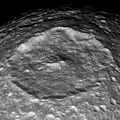
| ミマス | ハーシェルの中央丘 | 約7,000m[38] | 天体衝突 | 太陽系の天体の最も大きなクレーターの一覧も参照。 |
| ディオネ | ジャニコロ尾根 (Janiculum Dorsa) | 約2,000m | 地殻運動 | 周囲の地殻が約500m落ち込んでいる。 |
| タイタン | ミスリム山脈 (Mithrim Montes) | 2,000m[39] | 地殻運動 (?) | 大域的収縮に起因して形成されている可能性がある[39] |
| ドゥーム山 (Doom Mons) | 1,450m[40] | 冷凍火山活動 (?) | 1,700mの深い陥没、ソトラ・パテラに隣接する[40]。 | |
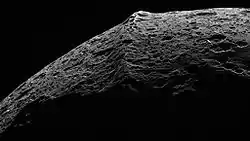
| イアペトゥス | 赤道上の尾根 | 約20,000m[41] | 未詳[† 8]。 | それぞれの山は測定されていない。 |
| オベロン | 未命名 ("limb mountain") | 約11,000m[38] | 天体衝突 (?) | 6kmという値がボイジャー2号接近直後与えられた[45]。 |



注釈
- しかしオリンポス山の直径はベスタを上回る
- Helman (2005), 20頁によると、 "the base to peak rise of Mount McKinley is the largest of any mountain that lies entirely above sea level, some 18000 feet"(マッキンリー山は完全に海面上に出ている山の中で麓からの比高は最大であり、5500mに達する。)
- 海抜約8,848m、深海平原からの高さ13km。
- キュリオシティの着陸地点(Bradbury Landing)の視点から約5250m高い[23]
- ゲールの中央丘は、堆積物の山に覆われていると考えられている。もしゲールが浸水している間その堆積物が堆積していたら、ゲールが侵食される前、一度 完全に堆積物によって埋まっていた可能性がある[22]。しかし、もし、reported 3 degree radial slopes of the mound's layersによって示唆されているように滑降風が侵食の原因であるとすれば、侵食は堆積物の山の成長を制限しただろう。[24][25]
- 太陽系内で最大[34]
- いくつかのイオのパテラは、放射状に広がった溶岩流に囲まれて(地形的に)高いところにあり、楯状火山となっている。これらの火山のほとんどは1km未満の起伏を示す。少数の山はそれ以上の起伏がある。例えば、ルワ・パテラ(イオの地形一覧#火口も参照)は300kmの幅に対し、2.5 - 3km起伏している。しかし、その傾きは1度程度である。[37]イオの小さい楯状火山の一握りは、急勾配で円錐形をしている。記載されている例では、幅60kmで、傾きは平均4°で、それが小型の山頂陥没地形に近づくにつれ6-7°に達する[37]
- 地殻の再調整を含む起源の仮説は自転と公転の同期に起因する扁平率の減少[42][43]ともとの環の軌道から外れた物質の堆積[44]に関連付けられている。
- 線状化された広角のhazcam(en:Hazcam)からの画像で、実際よりも急勾配に見える。最高峰は写っていない。
脚注
- “Surface”. MESSENGER web site. ジョンズ・ホプキンス大学/アップライド・フィジックス・ラボラトリー. 2012年4月4日閲覧。
- Oberst, J.; Preusker, F.; Phillips, R. J.; Watters, T. R.; Head, J. W.; Zuber, M. T.; Solomon, S. C. (2010). “The morphology of Mercury’s Caloris basin as seen in MESSENGER stereo topographic models”. Icarus 209 (1): 230–238. Bibcode: 2010Icar..209..230O. doi:10.1016/j.icarus.2010.03.009. ISSN 00191035.
- Fassett, C. I.; Head, J. W.; Blewett, D. T.; Chapman, C. R.; Dickson, J. L.; Murchie, S. L.; Solomon, S. C.; Watters, T. R. (2009). “Caloris impact basin: Exterior geomorphology, stratigraphy, morphometry, radial sculpture, and smooth plains deposits”. Earth and Planetary Science Letters 285 (3-4): 297–308. Bibcode: 2009E&PSL.285..297F. doi:10.1016/j.epsl.2009.05.022. ISSN 0012821X.
- Jones, Tom; Stofan, Ellen (2008). Planetology : Unlocking the secrets of the solar system. Washington, D.C.: ナショナルジオグラフィック協会. p. 74. ISBN 978-1-4262-0121-9
- Keep, M.; Hansen, V. L. (1994). “Structural history of Maxwell Montes, Venus: Implications for Venusian mountain belt formation”. Journal of Geophysical Research 99 (E12): 26015. Bibcode: 1994JGR....9926015K. doi:10.1029/94JE02636. ISSN 0148-0227.
- Otten, Carolyn Jones (2004年2月10日). “'Heavy metal' snow on Venus is lead sulfide”. Newsroom (セントルイス・ワシントン大学) 2012年12月10日閲覧。
- “PIA00106: Venus - 3D Perspective View of Maat Mons”. Planetary Photojournal. ジェット推進研究所 (1996年8月1日). 2012年6月30日閲覧。
- Robinson, C. A.; Thornhill, G. D.; Parfitt, E. A. (January 1995). “Large-scale volcanic activity at Maat Mons: Can this explain fluctuations in atmospheric chemistry observed by Pioneer Venus?”. Journal of Geophysical Research 100 (E6): 11755–11764. Bibcode: 1995JGR...10011755R. doi:10.1029/95JE00147 2013年2月11日閲覧。.
- “Mountains: Highest Points on Earth”. National Geographic Society. 2010年9月19日閲覧。
- “Haleakala National Park Geology Fieldnotes”. U.S. National Park Service. 2017年2月2日時点のオリジナルよりアーカイブ。2017年1月31日閲覧。
- “Teide National Park”. UNESCO World Heritage Site list. 国際連合教育科学文化機関. 2013年6月2日閲覧。
- “NOVA Online: Surviving Denali, The Mission”. NOVA. Public Broadcasting Corporation (2000年). 2007年6月7日閲覧。
- Adam Helman (2005). The Finest Peaks: Prominence and Other Mountain Measures. Trafford Publishing. ISBN 978-1-4120-5995-4 2012年12月9日閲覧。
- Mount Everest (1:50,000 scale map), prepared under the direction of ブラッドフォード・ウォッシュバーン for the Boston Museum of Science, the Swiss Foundation for Alpine Research, and the National Geographic Society, 1991, ISBN 3-85515-105-9
- Fred W. Price (1988). The Moon observer's handbook. London: Cambridge University Press. ISBN 0-521-33500-0
- Moore, Patrick (2001). On the Moon. London: Cassell & Co
- Wöhler, C.; Lena, R.; Pau, K. C. (12–16 March 2007). "The Lunar Dome Complex Mons Rümker: Morphometry, Rheology, and Mode of Emplacement". Proceedings Lunar and Planetary Science XXXVIII. League City, Texas: Dordrecht, D. Reidel Publishing Co. 2007年8月28日閲覧。
- Plescia, J. B. (2004). “Morphometric properties of Martian volcanoes”. Journal of Geophysical Research 109 (E3). Bibcode: 2004JGRE..109.3003P. doi:10.1029/2002JE002031. ISSN 0148-0227.
- Carr, M.H., 2006, The Surface of Mars, Cambridge, 307 p.
- Comins, Neil F. (4 January 2012). Discovering the Essential Universe. Macmillan. ISBN 978-1-4292-5519-6 2012年12月23日閲覧。
- JMARS MOLA elevation dataset. Christensen, P.; Gorelick, N.; Anwar, S.; Dickenshied, S.; Edwards, C.; Engle, E. (2007) "New Insights About Mars From the Creation and Analysis of Mars Global Datasets;" American Geophysical Union, Fall Meeting, abstract #P11E-01.
- “Gale Crater's History Book”. Mars Odyssey THEMIS web site. アリゾナ州立大学. 2012年12月7日閲覧。
- Anderson, R. B.; Bell III, J. F. (2010). “Geologic mapping and characterization of Gale Crater and implications for its potential as a Mars Science Laboratory landing site”. International Journal of Mars Science and Exploration 5: 76–128. Bibcode: 2010IJMSE...5...76A. doi:10.1555/mars.2010.0004.
- Wall, M. (2013年5月6日). “Bizarre Mars Mountain Possibly Built by Wind, Not Water”. Space.com. 2013年5月13日閲覧。
- Kite, E. S.; Lewis, K. W.; Lamb, M. P.; Newman, C. E.; Richardson, M. I. (2013). “Growth and form of the mound in Gale Crater, Mars: Slope wind enhanced erosion and transport”. Geology 41 (5): 543–546. doi:10.1130/G33909.1. ISSN 0091-7613.
- Agle, D. C. (2012年3月28日). “'Mount Sharp' On Mars Links Geology's Past and Future”. NASA. 2012年3月31日閲覧。
- Vega, P. (2011年10月11日). “New View of Vesta Mountain From NASA's Dawn Mission”. Jet Propulsion Lab's Dawn mission web site. NASA. 2011年10月22日時点のオリジナルよりアーカイブ。2012年3月29日閲覧。
- Schenk, P.; S., Marchi; D.P., O'Brien; D., Buczkowski; R., Jaumann; A., Yingst; T., McCord; R., Gaskell; T., Roatsch; H. E., Keller; C.A., Raymond; C.T., Russell (March 2012). "Mega-Impacts into Planetary Bodies: Global Effects of the Giant Rheasilvia Impact Basin on Vesta". 43rd Lunar and Planetary Science Conference. The Woodlands, Texas: LPI. contribution 1659, id.2757. 2012年9月6日閲覧。
- Perry, Jason (2009年1月27日). “Boösaule Montes”. Gish Bar Times blog. 2012年6月30日閲覧。
- Schenk, P.. “Boösaule Montes”. Io Mountain Database. 2012年6月30日閲覧。
- Schenk, Paul; Hargitai, Henrik; Wilson, Ronda; McEwen, Alfred; Thomas, Peter (2001). “The mountains of Io: Global and geological perspectives from Voyager and Galileo”. Journal of Geophysical Research 106 (E12): 33201. Bibcode: 2001JGR...10633201S. doi:10.1029/2000JE001408. ISSN 0148-0227.
- Schenk, P.. “Ionian Mons”. Io Mountain Database. 2012年6月30日閲覧。
- Schenk, P.. “Euboea Montes”. Io Mountain Database. 2012年6月30日閲覧。
- Martel, L. M. V. (2011年2月16日). “Big Mountain, Big Landslide on Jupiter's Moon, Io”. NASA Solar System Exploration web site. 2012年6月30日閲覧。
- Moore, J. M.; McEwen, A. S.; Albin, E. F.; Greeley, R. (1986). “Topographic evidence for shield volcanism on Io”. Icarus 67 (1): 181–183. Bibcode: 1986Icar...67..181M. doi:10.1016/0019-1035(86)90183-1. ISSN 00191035.
- Schenk, P.. “Unnamed volcanic mountain”. Io Mountain Database. 2012年12月6日閲覧。
- Schenk, P. M.; Wilson, R. R.; Davies, R. G. (2004). “Shield volcano topography and the rheology of lava flows on Io”. Icarus 169 (1): 98–110. Bibcode: 2004Icar..169...98S. doi:10.1016/j.icarus.2004.01.015.
- doi: 10.1016/j.icarus.2004.05.009
- Mitri, G.; Bland,M. T.; Showman, A. P.; Radebaugh, J.; Stiles, B.; Lopes, R. M. C.; Lunine, J. I.; Pappalardo, R. T. (2010). “Mountains on Titan: Modeling and observations”. Journal of Geophysical Research 115 (E10002): 1–15. Bibcode: 2010JGRE..11510002M. doi:10.1029/2010JE003592 2012年7月5日閲覧。.
- Lopes, R. M. C.; Kirk, R. L.; Mitchell, K. L.; LeGall, A.; Barnes, J. W.; Hayes, A.; Kargel, J.; Wye, L.; Radebaugh, J.; Stofan, E. R.; Janssen, M. A.; Neish, C. D.; Wall, S. D.; Wood, C. A.; Lunine, J. I.; Malaska, M. J. (2013-03-19). “Cryovolcanism on Titan: New results from Cassini RADAR and VIMS”. Journal of Geophysical Research: Planets 118: 1–20. Bibcode: 2013JGRE..118..416L. doi:10.1002/jgre.20062 2013年4月10日閲覧。.
- Giese, B.; Denk, T.; Neukum, G.; Roatsch, T.; Helfenstein, P.; Thomas, P. C.; Turtle, E. P.; McEwen, A. et al. (2008). “The topography of Iapetus' leading side”. Icarus 193 (2): 359–371. Bibcode: 2008Icar..193..359G. doi:10.1016/j.icarus.2007.06.005. ISSN 00191035.
- キャロリン・ポーコ; et al. (2005). “Cassini Imaging Science: Initial Results on Phoebe and Iapetus”. Science 307 (5713): 1237–1242. Bibcode: 2005Sci...307.1237P. doi:10.1126/science.1107981. ISSN 0036-8075. PMID 15731440. 2005Sci...307.1237P.
- Kerr, Richard A. (2006-01-06). “How Saturn's Icy Moons Get a (Geologic) Life”. Science 311 (5757): 29. doi:10.1126/science.311.5757.29. PMID 16400121.
- Ip, W.-H. (2006). “On a ring origin of the equatorial ridge of Iapetus”. Geophysical Research Letters 33 (16): L16203. Bibcode: 2006GeoRL..3316203I. doi:10.1029/2005GL025386. ISSN 0094-8276.
- Moore, P.; Henbest, N. (April 1986). “Uranus - the View from Voyager”. Journal of the British Astronomical Association 96 (3): 131–137. Bibcode: 1986JBAA...96..131M 2012年7月7日閲覧。.
関連項目
- 地球外の地形の一覧
- 山の一覧
- 国別の最高地点一覧
- 世界の山一覧 (高さ順)
- 地球外の火山一覧、火山の一覧#地球以外の火山
- モンス (惑星地質学)
外部リンク
- High resolution side view color image of Rheasilvia's central peak at Planetary.org (peak is at upper right)
- Color mosaic of Vesta's southern hemisphere - レアシルヴィア
- Color panorama of Aeolis Mons from 2012-09-21
- Gigapixel panorama of the Mt. Everest area by デイビット・ブリーシアーズ
This article is issued from Wikipedia. The text is licensed under Creative Commons - Attribution - Sharealike. Additional terms may apply for the media files.