オリオン座パイ4星
オリオン座π4星(オリオンざパイ4せい、π4 Orionis、π4 Ori)は、オリオン座にある連星である。視等級は3.7で、肉眼でもみることができる[1]。年周視差は約4.03ミリ秒で、それに基づいて計算した太陽からの距離は、810光年になる[2]。
| オリオン座π4星 π4 Orionis | ||
|---|---|---|
| 星座 | オリオン座 | |
| 見かけの等級 (mv) | 3.68[1] | |
| 位置 元期:J2000.0 | ||
| 赤経 (RA, α) | 04h 51m 12.3679849949s[2] | |
| 赤緯 (Dec, δ) | +05° 36′ 18.336776060″[2] | |
| 視線速度 (Rv) | 23.3 km/s[3] | |
| 固有運動 (μ) | 赤経: -3.879 ミリ秒/年[2] 赤緯: 3.305 ミリ秒/年[2] | |
| 年周視差 (π) | 4.0309 ± 0.3769ミリ秒[2] (誤差9.4%) | |
| 距離 | 810 ± 80 光年[注 1] (250 ± 20 パーセク[注 1]) | |
| 絶対等級 (MV) | -3.3[4] | |
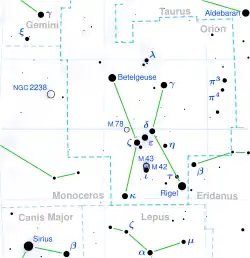  | ||
オリオン座π4星の位置。
| ||
| 軌道要素と性質 | ||
| 軌道長半径 (a) | > 3.38 ×10⁶ km[3] | |
| 離心率 (e) | 0.03[3] | |
| 公転周期 (P) | 9.5191 日[3] | |
| 近点引数 (ω) | 165°[3] | |
| 物理的性質 | ||
| 半径 | 9.1 R☉[5] | |
| 質量 | 12 / 1.5 M☉[4] | |
| 表面重力 | 4.0 G[6][注 2] | |
| 自転速度 | 39 km/s[6] | |
| スペクトル分類 | B2 III + B2 IV[6] | |
| 光度 | 19,726 L☉[7] | |
| 表面温度 | 22,120 K[6] | |
| 色指数 (B-V) | -0.157[1] | |
| 色指数 (V-I) | -0.16[1] | |
| 金属量[Fe/H] | -0.31(太陽比)[6] | |
| 年齢 | 15.4 ± 1.0 ×10⁶ 年[8] | |
| 他のカタログでの名称 | ||
| オリオン座3番星, BD+05 745, FK5 179, HD 30836, HIP 22549, HR 1552, SAO 112142[2] | ||
| ■Template (■ノート ■解説) ■Project | ||
特徴
オリオン座π4星は、分光連星で、周期9.5日、離心率0.03という軌道を公転している[3]。
主星はB型巨星で、スペクトル型はB2 IIIとされる[6]。主星のスペクトルには、ホウ素の大幅な欠乏が現れており、ホウ素の存在量は太陽より40倍以上少ないとみられる[9][10]。主星の質量は、太陽の12倍くらいあり、半径は、太陽のおよそ9倍である[8][5]。年齢は、1540万年くらいで、自転速度は39km/s以上と推定される[8][6]。光度は、太陽の2万倍程度で、有効温度は、およそ22,000Kと求められている[7][6]。
伴星については、はっきりしたことはわかっていない。質量は、主星の1-2割程度とみられ、スペクトル型はB2 IVとされているが、その根拠について詳細は明かされていない[4][6][9]。
名称
アメリカのアマチュア博物学者アレンによれば、オリオン座ο1星、ο2星、オリオン座π1星、π2星、π3星、π4星、π5星、π6星、オリオン座g星をまとめて、ペルシア語で「冠」を意味するAl Tāj、或いはアラビア語で「衣服の袖」を意味するAl Kummと呼ばれていた[11]。
中国では、オリオン座π4星は、参宿の持つ旗を意味する參旗という星官を、オリオン座ο1星、オリオン座ο2星、オリオン座6番星、オリオン座π1星、オリオン座π2星、オリオン座π3星、オリオン座π5星、オリオン座π6星と共に形成する。オリオン座π4星自身は、參旗七、つまり參旗の7番星と呼ばれる[12]。
脚注
注釈
- パーセクは1 ÷ 年周視差(秒)より計算、光年は1÷年周視差(秒)×3.2615638より計算
- 出典での表記は、
![{\displaystyle \log g[{\mbox{cgs}}]=3.59}](../I/0f3f1ac9d2bbb00fba53f1746b597666b8ced1ef.svg)
出典
- ESA (1997), The HIPPARCOS and TYCHO catalogues. Astrometric and photometric star catalogues derived from the ESA HIPPARCOS Space Astrometry Mission, ESA SP Series, 1200, Noordwijk, Netherlands: ESA Publications Division, Bibcode: 1997ESASP1200.....E, ISBN 9290923997
- “pi.04 Ori -- Spectroscopic binary”. SIMBAD. CDS. 2018年9月5日閲覧。
- Batten, A. H.; Fletcher, J. M.; Mann, P. J. (1978), “Seventh catalogue of the orbital elements of spectroscopic binary systems”, Publications of the Dominion Astrophysical Observatory Victoria 15: 121-295, Bibcode: 1978PDAO...15..121B
- den Boggende, A. J. F.; Lamers, H. J. G. L. M.; Mewe, R. (1979-11), “The nature of the secondaries in some single-line spectroscopic binaries from X-ray observations”, Astronomy & Astrophysics 80 (1): 1-8, Bibcode: 1979A&A....80....1D
- Pasinetti Fracassini, L. E.; et al. (2001-02), “Catalogue of Apparent Diameters and Absolute Radii of Stars (CADARS) - Third edition - Comments and statistics”, Astronomy & Astrophysics 367: 521-524, Bibcode: 2001A&A...367..521P, doi:10.1051/0004-6361:20000451
- Gies, Douglas R.; Lambert, David L. (1992-03-10), “Carbon, nitrogen, and oxygen abundances in early B-type stars”, Astrophysical Journal 387: 673-700, Bibcode: 1992ApJ...387..673G, doi:10.1086/171116
- Hohle, M. M.; Neuhäuser, R.; Schutz, B. F. (2010-04), “Masses and luminosities of O- and B-type stars and red supergiants”, Astronomische Nachrichten 331 (4): 349, arXiv:1003.2335, Bibcode: 2010AN....331..349H, doi:10.1002/asna.200911355
- Tetzlaff, N.; Neuhäuser, R.; Hohle, M. M. (2011-01), “A catalogue of young runaway Hipparcos stars within 3 kpc from the Sun”, Monthly Notices of the Royal Astronomical Society 410: 190-200, arXiv:1007.4883, Bibcode: 2011MNRAS.410..190T, doi:10.1111/j.1365-2966.2010.17434.x
- Morel, T.; Hubrig, S.; Briquet, M. (2008-04), “Nitrogen enrichment, boron depletion and magnetic fields in slowly-rotating B-type dwarfs”, Astronomy & Astrophysics 481 (2): 453-463, Bibcode: 2008A&A...481..453M, doi:10.1051/0004-6361:20078999
- Mendel, J. T.; et al. (2006-04), “Testing Rotational Mixing Predictions with New Boron Abundances in Main-Sequence B-Type Stars”, Astrophysical Journal 640 (2): 1039-1050, Bibcode: 2006ApJ...640.1039M, doi:10.1086/500252
- Allen, R. H. (1963), Star Names: Their Lore and Meaning, New York, NY: Dover Publications, Inc., ISBN 0-486-21079-0
- “中國古代的星象系統 (74): 畢宿天區” (中国語). AEEA 天文教育資訊網. 國立自然科學博物館 (2006年7月13日). 2018年9月8日閲覧。
関連項目
外部リンク
| 恒星 |
| ||||||||||||
|---|---|---|---|---|---|---|---|---|---|---|---|---|---|
| 太陽系外惑星 |
| ||||||||||||
| 星団 |
| ||||||||||||
| 星雲 |
| ||||||||||||
| 銀河 |
| ||||||||||||
 カテゴリ カテゴリ | |||||||||||||