コイサン諸語
コイサン諸語(コイサンしょご)は、アフリカの言語群。吸着音を共通の特徴として持つ。
| コイサン諸語 | |
|---|---|
| 話される地域 | カラハリ砂漠、タンザニア中央部 |
| 言語系統 | コイは牧畜民、サンは狩猟採集民。現生人類の最も古い言語とされる。ただし同一の語族とは証明されていない。 |
| 下位言語 | |
| ISO 639-2 / 5 | khi |
| ISO 639-5 | khi |
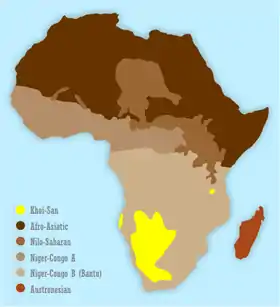 コイサン諸語の分布図(黄) | |
概要
歴史的にコイとサンの人々によって話されてきた。今日では南西アフリカのカラハリ砂漠とタンザニアの一部地域で(サンダウェ語、ハヅァ語)話される[1]。
特徴は吸着音を音素とすることや、50を超える吸着音と140を超える音素を持つクン語や、厖大な音素の目録を持つコン語を含むことである[1]。
話者のコイサン人種は現生人類最古の系統とされ[2][3][4][5][6][7][8]、吸着音は現生人類最古の言語の特徴を今に伝えるものと推測されている[9][10][11]。
含まれる5言語群は共通して吸着音を持つことから、かつては「コイサン語族」と呼ばれていたが、同系統とは証明されていないため、現在では独立した語族とされる[12][13]。
「アフリカの言語」も参照
分類
脚注
- 中川裕「コイサン諸語のクリック子音の記述的枠組み(<特集>アフリカ諸語の音声)」『音声研究』第2巻第3号、日本音声学会、1998年、52-62頁、CRID 1390282679764935168、doi:10.24467/onseikenkyu.2.3_52、ISSN 13428675。
- “人類発祥の地は東アフリカか、南アフリカか”. natgeo.nikkeibp.co.jp. 2023年6月29日閲覧。
- Lmurx (2007年7月13日). “africa science: Documentary Redraws Humans' Family Tree”. africa science. 2023年6月29日閲覧。
- Schuster, Stephan C.; Miller, Webb; Ratan, Aakrosh; Tomsho, Lynn P.; Giardine, Belinda; Kasson, Lindsay R.; Harris, Robert S.; Petersen, Desiree C. et al. (2010-02). “Complete Khoisan and Bantu genomes from southern Africa” (英語). Nature 463 (7283): 943–947. doi:10.1038/nature08795. ISSN 1476-4687.
- Pickrell, Joseph K.; Patterson, Nick; Loh, Po-Ru; Lipson, Mark; Berger, Bonnie; Stoneking, Mark; Pakendorf, Brigitte; Reich, David (2014-02-18). “Ancient west Eurasian ancestry in southern and eastern Africa”. Proceedings of the National Academy of Sciences 111 (7): 2632–2637. doi:10.1073/pnas.1313787111. ISSN 0027-8424.
- “Dwindling African tribe may have been most populous group on planet”. Science (2014年12月4日). 2023年6月30日閲覧。
- Ragsdale, Aaron P.; Weaver, Timothy D.; Atkinson, Elizabeth G.; Hoal, Eileen G.; Möller, Marlo; Henn, Brenna M.; Gravel, Simon (2023-05). “A weakly structured stem for human origins in Africa” (英語). Nature 617 (7962): 755–763. doi:10.1038/s41586-023-06055-y. ISSN 1476-4687.
- “ゲノムが教えるアフリカ人の移動史”. 2023年6月30日閲覧。
- アリス・ロバーツ、Roberts, Alice 著、野中香方子 訳『人類20万年 遙かなる旅路』文藝春秋、2013年5月15日、45 - 48頁。ISBN 978-4-16-376240-1。
- Knight, Alec; Underhill, Peter A.; Mortensen, Holly M.; Zhivotovsky, Lev A.; Lin, Alice A.; Henn, Brenna M.; Louis, Dorothy; Ruhlen, Merritt et al. (2003-03-18). “African Y chromosome and mtDNA divergence provides insight into the history of click languages”. Current biology: CB 13 (6): 464–473. doi:10.1016/s0960-9822(03)00130-1. ISSN 0960-9822. PMID 12646128.
- Traunmuller, Hartmut (2003). “Clicks and the idea of a human protolanguage”. Umeå University, Department of Philosophy and Linguistics PHONUM.
- Bonny Sands (1998) Eastern and Southern African Khoisan: Evaluating Claims of Distant Linguistic Relationships. Rüdiger Köppe Verlag, Cologne
- Gerrit Dimmendaal (2008) "Language Ecology and Linguistic Diversity on the African Continent", in Language and Linguistics Compass 2(5)
- Abdullahi, Mohamed Diriye (2001). Culture and Customs of Somalia. Greenwood Publishing Group. pp. 10-11. ISBN 0313313334 2015年7月閲覧。
This article is issued from Wikipedia. The text is licensed under Creative Commons - Attribution - Sharealike. Additional terms may apply for the media files.