ロイコアントシアニジン
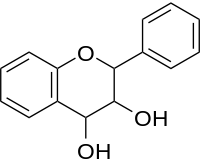
ロイコアントシアニジン(英: Leucoanthocyanidin)もしくはフラバン-3,4-ジオール (flavan-3,4-diol) は、アントシアニジンおよびアントシアニンに関連する無色の化合物群である。Anadenanthera peregrina に含有されるほか、Nepenthes burbidgeae, Nepenthes muluensis, Nepenthes rajah, Nepenthes tentaculata, Nepenthes × alisaputrana など、ウツボカズラ属のいくつかの種に含まれる。
| Leucoanthocyanidin | |
|---|---|
 | |
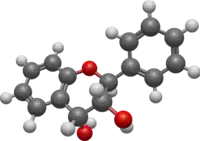 | |
2-Phenyl-3,4-dihydro-2H-1-benzopyran-3,4-diol | |
別称 Flavan-3,4-diol | |
| 識別情報 | |
| CAS登録番号 | 5023-02-9  |
| PubChem | 5318979 |
| UNII | EH726HE44D |
| |
| 特性 | |
| 化学式 | C15H14O3 |
| モル質量 | 242.27 g mol−1 |
| 特記なき場合、データは常温 (25 °C)・常圧 (100 kPa) におけるものである。 | |
ロイコアントシアニジンに分類される化合物として、以下のようなものが挙げられる。
- ロイコシアニジン
- ロイコデルフィニジン
- ロイコフィセチニジン
- ロイコマルビジン
- ロイコペラルゴニジン
- ロイコペオニジン
- ロイコロビネチニジン
- メラカシジン
- テラカシジン[1]
ロイコアントシアニジンは、Matthiola incana(ストック)の花におけるアントシアニジン生合成の中間体であることが示されている。
ベイト=スミスは1954年、ロイコアントシアニンの単離のためにフォレスタル溶媒を用いることを推奨した[2]。
代謝
ロイコシアニジンオキシゲナーゼはフラバン-3,4-ジオールを基質として3-ヒドロキシアントシアニジンを生成する[3]。 モモのゲノムにおいてこの酵素をコードする遺伝子 (PpLDOX) は特定されており、その発現についてはVitis vinifera(ヨーロッパブドウ)における研究がある。
出典
- Clark-Lewis, JW; Dainis, I (1967). “Flavan derivatives. XIX. Teracacidin and isoteracacidin from Acacia obtusifolia and Acacia maidenii heartwoods; Phenolic hydroxylation patterns of heartwood flavonoids characteristic of sections and subsections of the genus Acacia”. Australian Journal of Chemistry 20 (10): 2191–2198. doi:10.1071/CH9672191.
- Bate-SMITH, EC (September 1954). “Leuco-anthocyanins. 1. Detection and identification of anthocyanidins formed leuco-anthocyanins in plant tissues”. Biochem. J. 58 (1): 122–5. doi:10.1042/bj0580122. PMC 1269852. PMID 13198862.
- “leucoanthocyanidin dioxygenase on mondofacto.com”. 2012年3月4日時点のオリジナルよりアーカイブ。2009年9月3日閲覧。
This article is issued from Wikipedia. The text is licensed under Creative Commons - Attribution - Sharealike. Additional terms may apply for the media files.