ヒ化ホウ素
ヒ化ホウ素(ヒかホウそ、Boron arsenide)は、ホウ素とヒ素からなる化合物で、化学式はBAsである。亜ヒ化物B12As2等、ホウ素とヒ素の化合物は他にも知られている。純粋なヒ化ホウ素の合成は非常に難しく、単結晶は常に欠陥を含む。
| ヒ化ホウ素 | |
|---|---|
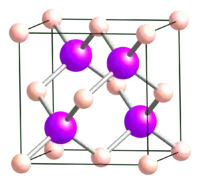 | |
| 識別情報 | |
| CAS登録番号 | 12005-69-5  |
| PubChem | 10285774 |
| ChemSpider | 8461243 |
| |
| |
| 特性 | |
| 化学式 | BAs |
| モル質量 | 85.733 g/mol[1] |
| 外観 | 茶色立方体結晶[1] |
| 密度 | 5.22 g/cm3[1] |
| 融点 |
1100 °C, 1373 K, 2012 °F (分解[1]) |
| 水への溶解度 | 不溶 |
| バンドギャップ | 1.82 eV |
| 熱伝導率 | 1300 W/(m·K) (300 K) |
| 構造 | |
| 結晶構造 | 立方体 (閃亜鉛鉱型), cF8, No. 216 |
| 空間群 | F43m |
| 格子定数 (a, b, c) | a = 0.4777 nm Å |
| 関連する物質 | |
| その他の陰イオン | 窒化ホウ素 リン化ホウ素 アンチモン化ホウ素 |
| その他の陽イオン | ヒ化アルミニウム ヒ化ガリウム ヒ化インジウム |
| 特記なき場合、データは常温 (25 °C)・常圧 (100 kPa) におけるものである。 | |
| 亜ヒ化ホウ素 | |
|---|---|
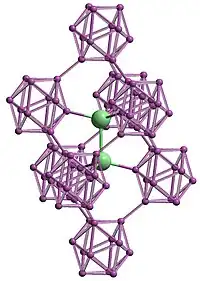 | |
| 識別情報 | |
| CAS登録番号 | 12005-70-8 |
| 特性 | |
| 化学式 | B12As2 |
| モル質量 | 279.58 g/mol |
| 密度 | 3.56 g/cm3[2] |
| 水への溶解度 | 不溶 |
| バンドギャップ | 3.47 eV |
| 構造 | |
| 結晶構造 | 菱面体, hR42, No. 166 |
| 空間群 | R3m |
| 格子定数 (a, b, c) | a = 0.6149 nm Å,b = 0.6149 nm Å,c = 1.1914 nm Å |
| 格子定数 (α, β, γ) | α = 90°, β = 90°, γ = 120° |
| 関連する物質 | |
| その他の陰イオン | 亜酸化ホウ素 |
| 特記なき場合、データは常温 (25 °C)・常圧 (100 kPa) におけるものである。 | |
性質
ヒ化ホウ素はIII-V族半導体であり、格子定数は0.4777 nm、間接バンドギャップは1.82 eVと測定される。920℃を超えると、B12As2に分解すると報告されている[3]。融点は2076℃である。熱伝導率は非常に高く、300Kで約1300 W/(m・K)である[4]。
基本的な物理的性質は、以下のように測定されている。
亜ヒ化物
二十面体構造を持つB12As2を含む亜ヒ化物もある。ホウ素原子と2原子からなるAs-As鎖の集合体で、R3m空間群の菱面体である。広いバンドギャップ(3.47 eV)で、放射による損傷に対して自己治癒能を持つ半導体になる[6]。炭化ケイ素等の基質上で成長させられる[7]。太陽電池への応用も提案されているが[5][8]、この目的では今のところ使われていない。
利用
電子機器の熱管理への利用が期待されている。実験的に窒化ガリウムトランジスタと組み合わせて、炭化ケイ素またはダイヤモンド基質上でGaN-BAsヘテロ構造を作ると、最高のGaN高電子移動度トランジスタよりも良いパフォーマンスを示した。ヒ化ホウ素複合体は、伝導性が高く柔軟な放熱材料として開発された。
第一原理計算によると、ヒ化ホウ素の熱伝導率は室温で2200 W/(m・K)以上とかなり高く、これはダイヤモンドやグラファイトに匹敵する値である[9]。その後の実験では、欠陥が多かったため、わずか190 W/(m・K)の測定結果となった[10][11]。フォノン散乱を取り入れたより最新の第一原理計算では、熱伝導率は1400 W/(m・K)と予測される[12]。その後、欠陥のないヒ化ホウ素結晶の合成が実現し、予測と合致する1300 W/(m・K)という測定値が得られた[4]。少量の欠陥を含む結晶では、900-1000 W/(m・K)の熱伝導率となる[13][14]。
出典
- Haynes, William M., ed (2011). 化学と物理のCRCハンドブック (92nd ed.). CRC Press. p. 4.53. ISBN 1439855110
- Villars, Pierre (ed.) "B12As2 (B6As) Crystal Structure" in Inorganic Solid Phases, Springer, Heidelberg (ed.) SpringerMaterials
- Chu, T. L; Hyslop, A. E (1974). “Preparation and Properties of Boron Arsenide Films”. Journal of the Electrochemical Society 121 (3): 412. Bibcode: 1974JElS..121..412C. doi:10.1149/1.2401826.
- Kang, J.; Li, M.; Wu, H.; Nguyen, H.; Hu, Y. (2018). “Experimental observation of high thermal conductivity in boron arsenide”. Science 361 (6402): 575–578. Bibcode: 2018Sci...361..575K. doi:10.1126/science.aat5522. PMID 29976798.
- Geisz, J. F; Friedman, D. J; Olson, J. M; Kurtz, Sarah R; Reedy, R. C; Swartzlander, A. B; Keyes, B. M; Norman, A. G (2000). “BGaInAs alloys lattice matched to GaAs”. Applied Physics Letters 76 (11): 1443. Bibcode: 2000ApPhL..76.1443G. doi:10.1063/1.126058.
- Carrard, M; Emin, D; Zuppiroli, L (1995). “Defect clustering and self-healing of electron-irradiated boron-rich solids”. Physical Review B 51 (17): 11270–11274. Bibcode: 1995PhRvB..5111270C. doi:10.1103/PhysRevB.51.11270. PMID 9977852.
- Chen, H.; Wang, G.; Dudley, M.; Xu, Z.; Edgar, J. H.; Batten, T.; Kuball, M.; Zhang, L. et al. (2008). “Single-Crystalline B12As2 on m-plane (1100) 15R-SiC”. Applied Physics Letters 92 (23): 231917. Bibcode: 2008ApPhL..92w1917C. doi:10.1063/1.2945635. hdl:2097/2186.
- Boone, J. L. and Vandoren, T. P. (1980) Boron arsenide thin film solar cell development, Final Report, Eagle-Picher Industries, Inc., Miami, OK. abstract.
- An unlikely competitor for diamond as the best thermal conductor, Phys.org news (July 8, 2013)
- Lv, Bing; Lan, Yucheng; Wang, Xiqu; Zhang, Qian; Hu, Yongjie; Jacobson, Allan J; Broido, David; Chen, Gang et al. (2015). “Experimental study of the proposed super-thermal-conductor: BAs”. Applied Physics Letters 106 (7): 074105. Bibcode: 2015ApPhL.106g4105L. doi:10.1063/1.4913441. hdl:1721.1/117852.
- Zheng, Qiang; Polanco, Carlos A.; Du, Mao-Hua; Lindsay, Lucas R.; Chi, Miaofang; Yan, Jiaqiang; Sales, Brian C. (6 September 2018). “Antisite Pairs Suppress the Thermal Conductivity of BAs”. Physical Review Letters 121 (10): 105901. arXiv:1804.02381. Bibcode: 2018PhRvL.121j5901Z. doi:10.1103/PhysRevLett.121.105901. PMID 30240242.
- Feng, Tianli; Lindsay, Lucas; Ruan, Xiulin (2017). “Four-phonon scattering significantly reduces intrinsic thermal conductivity of solids”. Physical Review B 96 (16): 161201. Bibcode: 2017PhRvB..96p1201F. doi:10.1103/PhysRevB.96.161201.
- Li, Sheng; Zheng, Qiye; Lv, Yinchuan; Liu, Xiaoyuan; Wang, Xiqu; Huang, Pinshane Y.; Cahill, David G.; Lv, Bing (2018). “High thermal conductivity in cubic boron arsenide crystals”. Science 361 (6402): 579–581. Bibcode: 2018Sci...361..579L. doi:10.1126/science.aat8982. PMID 29976796.
- Tian, Fei; Song, Bai; Chen, Xi; Ravichandran, Navaneetha K; Lv, Yinchuan; Chen, Ke; Sullivan, Sean; Kim, Jaehyun et al. (2018). “Unusual high thermal conductivity in boron arsenide bulk crystals”. Science 361 (6402): 582–585. Bibcode: 2018Sci...361..582T. doi:10.1126/science.aat7932. PMID 29976797.
外部リンク
- 2020 paper by Malica and Dal Corso - Temperature dependent elastic constants and thermodynamic properties of BAs: An ab initio investigation
- Matweb data
- King, R. B. (1999). Boron Chemistry at the Millennium. New York: Elsevier. ISBN 0-444-72006-5
- Ownby, P. D. (1975). “Ordered Boron Arsenide”. Journal of the American Ceramic Society 58 (7–8): 359–360. doi:10.1111/j.1151-2916.1975.tb11514.x.